
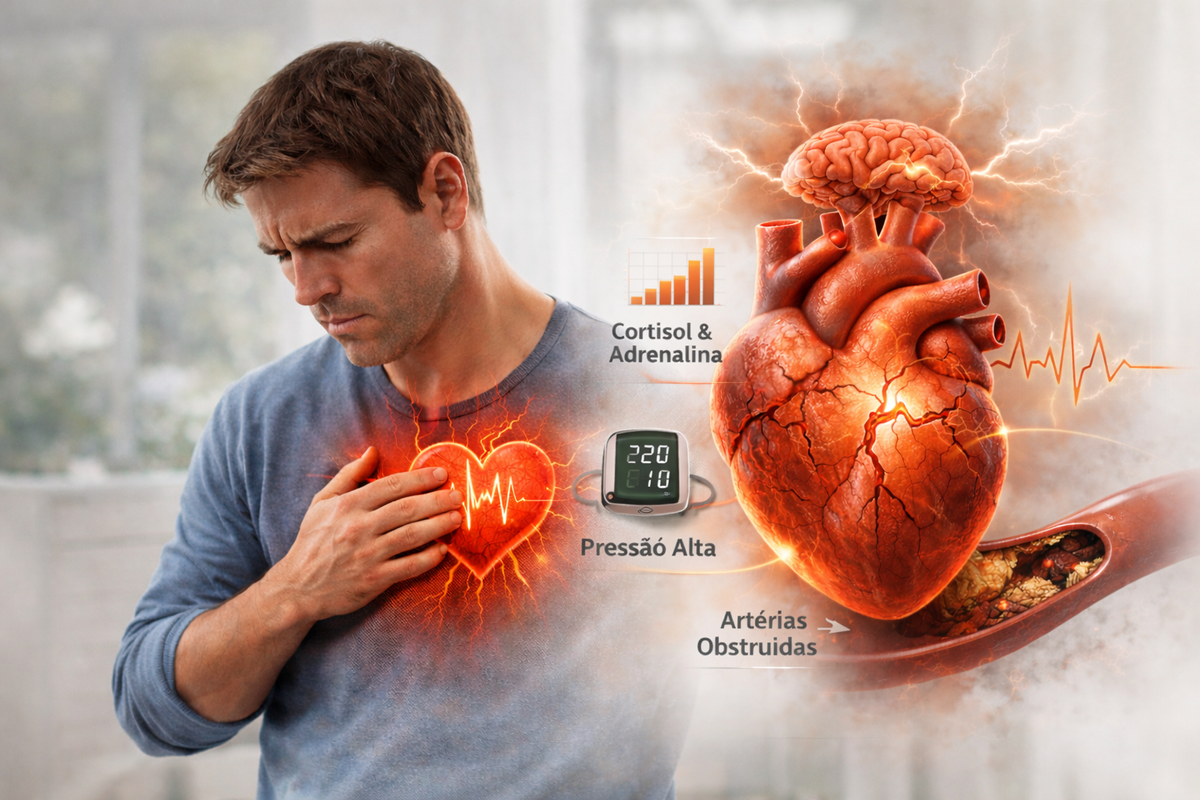
Learn how stress affects hormones and blood vessels, increases cardiovascular risk, and why managing tension is part of prevention.
Stress often seems emotional and temporary. However, it works as a complex physiological response. In this way, it can directly affect the heart and blood vessels.
“Stress is not only emotional, it is physiological. It acts directly on the heart,” explains Dr. Adriano Faustino, a physician specialized in metabology and functional medicine and a director at the Brazilian Society of Longevity Medicine (SBML).
What stress means to the body
When a person stays in constant alert, the sympathetic nervous system activates repeatedly. Next, hormones such as cortisol and adrenaline rise. This can increase blood pressure and promote inflammation.
In addition, the process can damage the endothelium, the inner lining of blood vessels. This is where the blockage that precedes a heart attack can develop. Therefore, wear and tear may build over time.
“The heart was not designed to live in a permanent emergency,” the doctor warns.
How stress affects the heart
The impact happens mainly in two ways. On one hand, chronic reactivity gradually strains the cardiovascular system. In this manner, ongoing exposure to stress hormones can raise blood pressure and support inflammation and metabolic dysfunction.
“The body does not understand speeches. It understands hormones, chemical discharge,” Dr. Adriano Faustino adds.
On the other hand, acute triggers can act as a spark. A sudden adrenaline surge may cause coronary artery spasm. As a result, blood pressure can rise abruptly, especially in people with already fragile arteries.
“Often, a heart attack happens after an intense emotional shock because the heart was already vulnerable,” the specialist explains.
Data and evidence on cardiovascular risk
Cardiovascular diseases remain the leading cause of death in Brazil. According to the Brazilian Society of Cardiology (SBC), they account for around 400,000 deaths each year. Meanwhile, recognition of stress and mental health in prevention continues to grow.
International epidemiological studies link high stress levels to a higher risk of cardiovascular events. These include myocardial infarction and stroke. In addition, psychosocial stress is now recognized as a relevant risk factor for coronary artery disease.
“The heart does not fail suddenly. It wears down under constant pressure until it cannot take it anymore,” Dr. Adriano Faustino says.
Confirmed risks and normalized stress
Research suggests persistent stress increases the likelihood of developing coronary disease over time. In addition, stress after a heart attack is associated with higher odds of future cardiac events. Anxiety and depression also connect strongly to cardiovascular risk through inflammatory and hormonal pathways.
A key challenge is how people normalize daily pressure. Many live under extreme demands and see it as unavoidable. However, the body reacts with the same hormonal activation to emotional or physical stress.
“People say they are just under pressure, at the limit, holding on. But the body collects the debt,” Dr. Adriano Faustino notes.
Factors that compound stress
Stress can also encourage behaviors that raise heart risk. Therefore, the effect grows stronger when chronic tension combines with unhealthy habits. The factors cited include smoking, unbalanced diet, physical inactivity, and excessive weight gain.
When these elements accumulate, cardiovascular risk tends to increase. For this reason, experts stress attention to both habits and warning signs. Next, gradual changes can reduce the strain on the cardiovascular system.
Prevention starts with stress management
Managing stress is not a luxury but a cardiovascular prevention strategy. Relaxation techniques, regular physical activity, and adequate sleep help reduce hormonal overload. In addition, psychological support and cutting behavioral risk factors can strengthen protection.
“Everything has a limit. The body always gives signs before it collapses,” Dr. Adriano Faustino concludes.
Who is Dr. Adriano Faustino
Physician, graduated from UFMG.
Director at the Brazilian Society of Longevity Medicine (SBML) and the Brazilian Society of Obesity Medicine (SBEMO).
Coordinator of the Obesity and Metabolic Syndrome outpatient clinic at Hospital Regional de Betim/MG.
Training in Geriatrics, Clinical Nutrition, Functional Medicine, Hormonal Physiology, and Integrative Oncology.
Board-certified specialist in Legal Medicine and Medical Expertise.
University professor in Legal Medicine, Medical Anatomy, First Aid, and Health Legislation.
Former postgraduate professor at Fundação Unimed and in the Health Master’s program at Milton Campos Law School (MG).
Developer of the C.A.U.S.A. Protocol – Cancer, Self-care, Unity, Health, and Action.
Creator of the Saúde Máxima Program and the Investigative Medicine Protocol.
Author of the book Cientificamente Divino – Princípios bíblicos e científicos para uma saúde máxima.