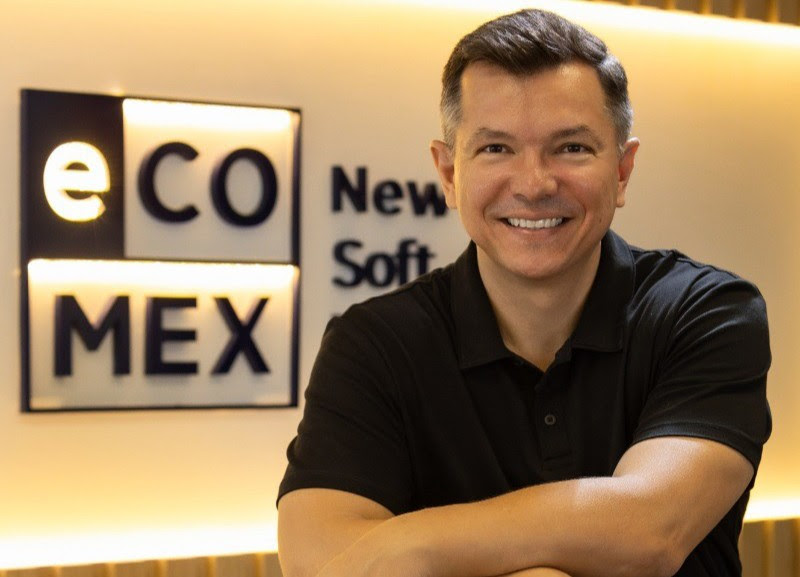
Op-ed by André Barros explains how government reform, new technologies and a younger generation of leaders are transforming Brazilian foreign trade.
A structural shift in Brazilian trade
Brazilian foreign trade is undergoing one of the deepest transformations in its history, argues André Barros, CEO of eComex. The process goes far beyond digitizing paperwork or adopting new tools. It is a structural transition involving government, companies, technologies and, above all, people.
In recent years, the rollout of the Single Portal for Foreign Trade (PUCOMEX) has been a turning point. The federal initiative centralizes information, integrates government agencies and simplifies international trade procedures. As a result, it cuts costs and increases predictability for cross-border operations.
Barros compares the impact of PUCOMEX, in scope and depth, to that of Tax Reform in the fiscal sphere. The platform is seen as a watershed for the sector. It also signals a stronger public commitment to modernizing the business environment.
Technology democratizes innovation in comex
In parallel, foreign trade is being reshaped by unprecedented technological acceleration. The widespread adoption of artificial intelligence, automation, blockchain and cloud computing has made innovation more accessible. These tools now reach companies of different sizes with lower barriers to entry.
In day-to-day operations, such technologies eliminate repetitive tasks and reduce operational errors. Intelligent systems organize data, cross-check information and automate critical workflows. Consequently, professionals gain time and clarity to focus on strategic decisions.
According to Barros, technology is no longer just a support layer; it has moved to the core of management. Robots, AI agents and advanced platforms enable faster, safer and more efficient operations. Data-driven trade becomes the new standard.
A new generation reshapes the role of trade
This technological revolution coincides with a generational shift inside companies. A new group of leaders, raised in a digital environment and connected to global trends, is taking charge. They see foreign trade not as a back-office function, but as a strategic pillar for global competitiveness.
From this perspective, comex goes beyond executing imports and exports. It becomes central to decisions on markets, logistics, risk and pricing. Foreign trade earns a seat at the table where long-term strategies are defined.
The result is a more open, collaborative and results-oriented mindset. Professionals seek partnerships, share knowledge and rely more heavily on performance indicators. This helps create an environment of continuous innovation.
The “Fantastic New World of Comex”
In Barros’s view, three forces now converge to define a new era: government, technology and people. He describes this moment as the “Fantastic New World of Comex”. The concept reflects not only technological progress, but also the human transformation that comes with it.
After the analog transformation of the industrial age and the digital revolution of recent decades, we are now in a human transformation phase. The market requires adaptable professionals who combine technical knowledge with empathy, creativity and analytical thinking. In this context, technology augments, rather than replaces, human capabilities.
Robots and AI agents take over mechanical, repetitive tasks. People, in turn, focus on what truly adds value: thinking, creating and making complex decisions. Human capital becomes even more central to the future of foreign trade.
Less friction, more efficiency and purpose
By nature, foreign trade is an intermediate activity, yet it is critical for the country. Without it, entire production chains come to a halt. For this reason, its modernization has broad economic repercussions.
In the synthesis offered by Barros, the sector is moving towards less friction and greater efficiency. Processes are becoming simpler, more predictable and more transparent. At the same time, work gains a clearer sense of purpose.
According to the executive, this is the true meaning of the fantastic new world now taking shape. An ecosystem that is more integrated, collaborative and human, where technology, government and professionals move in step. The ultimate goal is to lift Brazil to a new level of global competitiveness.